My Sister Encouraged Her Son to Smash My Brand-New Car Then She Forgot I Had Never Signed Her Mortgage Papers
The job also means I know better than most people exactly how thin the line is between an accident and a story someone tells about an accident. I’ve sat across from claimants who swore up and down a parking lot dent had appeared out of nowhere, and I’ve watched security footage prove otherwise in under 90 seconds. I’ve learned to trust documentation over declarations every single time, because declarations are just what people want to be true and documentation is what actually happened.
I didn’t think of myself as bringing that instinct home with me. I just always had, apparently, a folder open somewhere in the back of my head, waiting.
My sister has never had a job that lasted longer than eight months. She married Doug when she was 23, had Jeremy at 25, and somewhere in there decided that the entire concept of telling a child no was a form of violence she wasn’t willing to commit. I used to think this was just a philosophy she’d read about and liked the sound of. Over the years, I came to understand it was something narrower and more specific. Kelsey doesn’t discipline Jeremy because disciplining Jeremy would require Kelsey to be the bad guy in a story, even for 30 seconds. And Kelsey has never in her life been willing to be the bad guy in a story if there was any way to hand that role to someone else.
I’d been the someone else more times than I could count. The overprotective aunt, the uptight one, the one who just doesn’t get kids. I’d absorbed it for years the way you absorb weather, because it was easier than the alternative, which was watching my mother’s face do the thing it does when her daughters disagree in front of her. A kind of flinching stillness, like she’s bracing for a blow that never quite lands, but never quite stops being possible either.
I want to explain a little more about the shape of our family, because it matters to everything that followed. Our parents, Diane and Walter, ran a small hardware store for most of my childhood, unglamorous, steady work that put three kids through the same school district without much fanfare. Marcus is the oldest, five years ahead of me, steady and quiet in a way that made him easy to overlook at family gatherings even though he was, in every practical sense, the most reliable person in our family. I came next. Kelsey came last, three years younger than me, and somewhere in the family’s collective mythology she became “the sensitive one,” a label that started, I think, as genuine concern when she struggled through a rough adolescence, and calcified over the decades into a permanent excuse for whatever she did next.
I watched that pattern solidify slowly, year by year, the way you watch a crack in a foundation before you understand it’s actually structural. Kelsey missed curfew, and it was because she was “finding herself.” Kelsey dropped out of community college twice, and it was because the programs “weren’t right for her.” Kelsey borrowed money from our parents that never quite got paid back, and somehow the conversation always ended with my mother apologizing to her for not having understood her needs sooner.
I built my own adult life quietly, almost defensively, around the opposite instinct. I finished my degree. I took the claims adjuster job right out of school because it paid steadily and the benefits were good, and I stayed with it because I turned out to be genuinely good at it, methodical in a way that suited both the work and, I think, some deeper need in me to have at least one part of my life where the facts simply spoke for themselves and nobody could argue me out of them with enough charm.
I bought the Accord with money I’d been not spending since I was 28. Every bonus, every overtime check straight into an account I’d made deliberately hard to access. No debit card, no app on my phone, just a paper statement that came once a month and made me feel every single time like I was getting away with something.
I picked it up on a Friday. I sat in the driver’s seat in the dealership lot for five full minutes before I even started the engine. Just breathing in that smell, running my hand along the dash, feeling like a person who had finally actually built something.
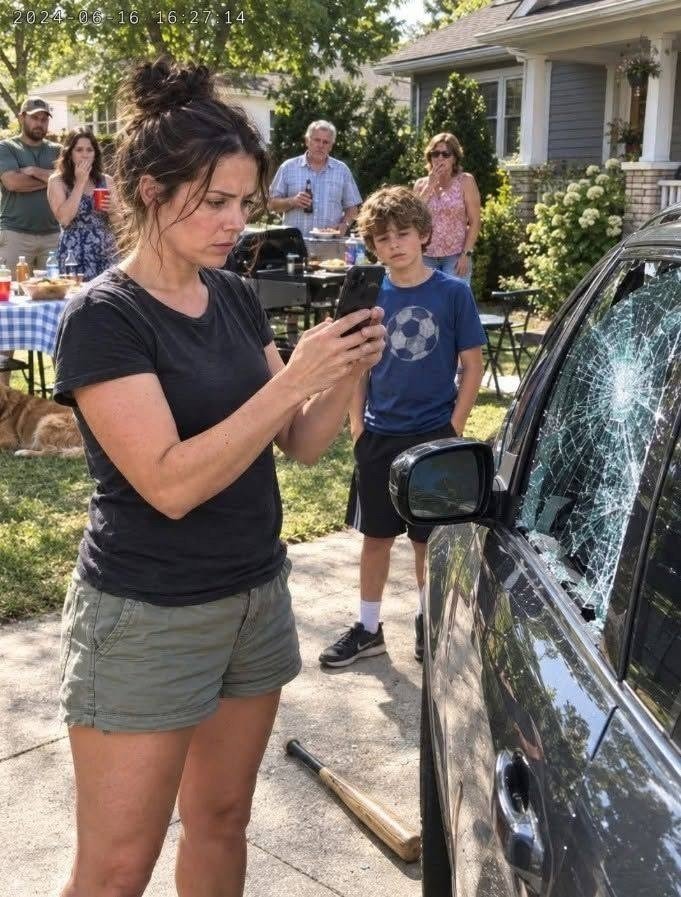
I threw a small party the following weekend. My parents, Kelsey, Doug, Jeremy, my brother Marcus, and his wife. Nothing fancy. A cookout in my own backyard. The car parked proudly in the driveway where everyone would walk right past it on the way in.
I asked Kelsey for exactly one thing. Watch Jeremy. Keep him away from the car.
She did the smile. The specific Kelsey smile that means you’re being difficult and I’m choosing to be gracious about it. “He’s a good boy, Kristen. Relax.”
I should have followed him outside the second I noticed how good he was being. Jeremy was suspiciously perfect that whole afternoon. Please and thank you. Napkin in his lap. Helped carry the lemonade pitcher without being asked, which for Jeremy was roughly equivalent to volunteering for the Peace Corps. Every adult in the yard commented on it at some point. Doug, beaming, said something about how he must be growing up. And I remember thinking, even then, in the part of my brain that does this for a living, “This data doesn’t fit the pattern.”
Twice during the afternoon, I caught him glancing toward the driveway window with a small private smile. The specific smile of someone who is in on a joke nobody else has heard yet. Both times, I told myself I was reading too much into a kid looking out a window. I do this for a living, catching the thing that doesn’t fit, and I still talked myself out of it because it is exhausting to be suspicious of your own family at your own party and because some tiny stupid hopeful part of me wanted for once to just enjoy something I’d built without bracing for it to be taken from me.